BLDC Motor for Fans uses advanced electronics to save more electricity—a crucial advantage for Indian households seeking efficient cooling.
BLDC motor for fan is like a summer essential nowadays. You switch on your fan and expect cool air, but it just blows hot air around. But as the blades start to move, you see something else: your power bill going up each month. Most of us don't think about the motor in our fans. As long as we see the fan moving, we’re happy. But here's the fact: not all fans are the same.
In the past ten years, fan tech has made a big jump. Meet the BLDC fan, it stands for Brushless Direct Current motor fan: a smart pick that brings strong air flow, very quiet work, and big cuts in energy use. If you've been asking why everyone is all about BLDC fans, this blog will show you how they run and why they beat the old fans.
You’ve heard about it many times, but you still don’t know. At first glance, a BLDC fan seems just like any other ceiling fan. Smooth blades, a motor cover, maybe even a cool look for your rooms. But the real trick is inside the motor.
Brushless Direct Current; that’s what BLDC stands for. Gone are the days of old motors that run on brushes and use up more power than necessary. The new BLDC motor has smart tech to handle spinning. This change makes them way more efficient, tough, and exact.
In easy words: A regular fan turns too much electricity into heat. A BLDC fan changes nearly all the power it gets into moving air.
That's why homes, work spots, and many places in India are moving to use BLDC fans.
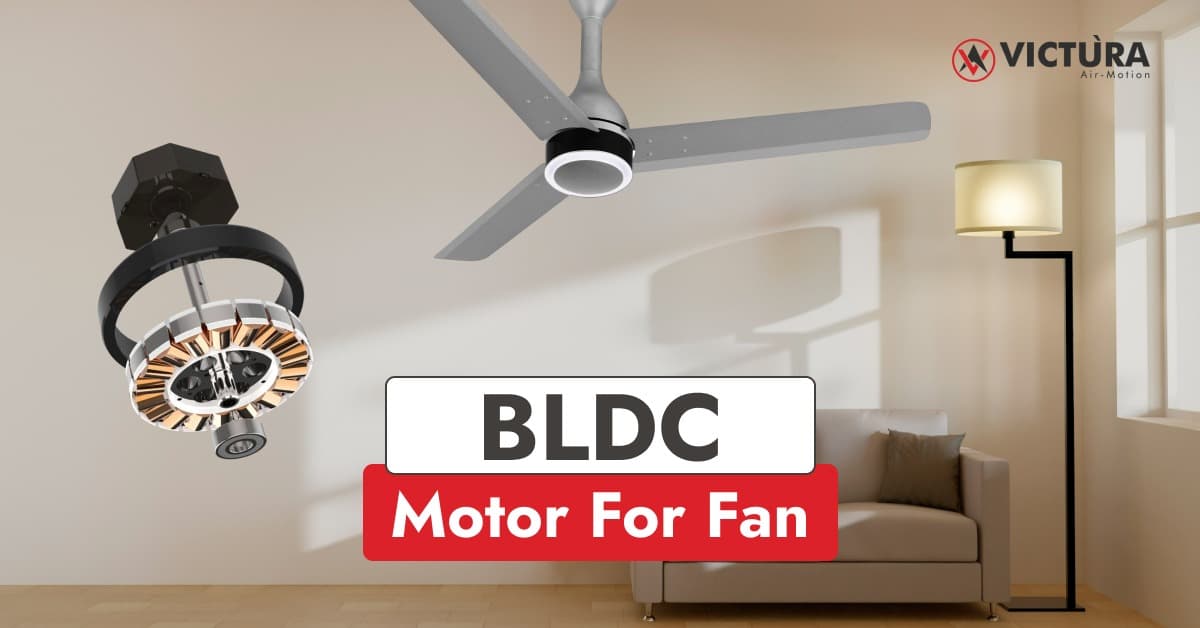
To understand why the BLDC motor fan is so efficient, let’s peek inside the motor. Here are the major components that make it special:
1. Stator and Rotor
Stator: Fixed part with copper wires.
Rotor: Moving part with strong magnets.
2. Electronic Controller (Driver Circuit)
This is the brain of the fan. It takes over the job of the old brushes in usual motors and flips the current on its own.
3. Permanent Magnets
Rather than just using power pulls, BLDC motors use top-grade permanent magnets in the rotor, making them stronger and more able to save power.
4. Hall Sensors
These sensors keep an eye on where the rotor is and help the controller send power correctly, making the fan run smoothly and quietly.
5. Remote/Smart Controls (optional)
Many BLDC fans come with remote control, sleep mode, or features made possible by the electronic controller.
All these parts work as a team to cut down on power waste and boost how well it works.
So, how does this smart motor make the blades go around?
Here's an easy look at it:
1. DC Power Input: The fan runs on direct current. In India, the AC supply is converted into DC using an electronic circuit.
2. Electronic Commutation: Instead of brushes physically switching the current (like in a traditional motor), the BLDC fan’s controller manages the current electronically.
3. Magnetic Interaction: The controller puts current into the stator windings in a set order. This makes a spinning magnetic field.
4. Rotor Movement: The fixed magnets on the rotor match up with the spinning magnetic field, making the rotor (and so the blades) turn.
5. Precise Speed Control: All controls done with a remote, the speed is truer, smoother, and works better.
See it as moving from an old typewriter to a new laptop; the task stays the same, but the way it works, the hold, and the ease are much better.
No, they don’t. Instead, they have a PCB (printed circuit board) on the inside that controls the switching and the speed.
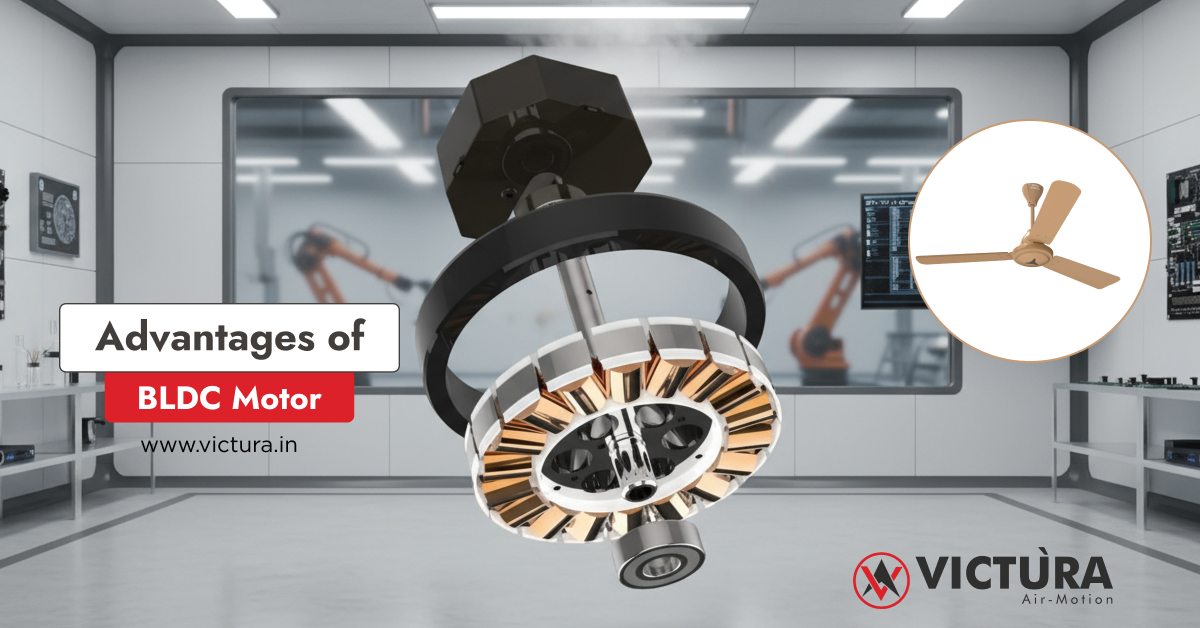
Now that you know what they do, let’s look at why they are the talk of the town:
1. Massive Energy Savings
A BLDC fan consumes around 28–35 watts at full speed, compared to 70–80 watts of a conventional fan. This means you save almost 50–65% on your electricity bills.
Ex: Victùra Airmotion – Renacer
2. Silent Operation
Since the BLDC motor has no brushes, it works silently. No humming, no buzzing, just clean airflow.
Ex: Victùra Airmotion – Glider
3. Longer Life
There are fewer cogs in the BLDC motor machine, ultimately saving it from wear and tear. It’s minimal and efficient.
Ex: Victùra Airmotion – Aethra
4. Stable Performance in Voltage Fluctuations
Even if your home experiences low or fluctuating voltage, BLDC fans deliver consistent airflow.
Ex: Victùra Airmotion – Eco Wind
5. Smart Features
Remote control, sleep timers, you name it. It’s a digital world we live in; why should the ceiling fan fall behind the trend?
Ex: Victùra Airmotion – Aeroflow
6. Eco-Friendly
Less power consumption is better for the environment. Less carbon in the atmosphere, happier planet, healthier people.
Ex: Victùra Airmotion – Aerowind
If all these smart features of the BLDC fan appeal to you, Victùra Airmotion fans might pique your interest.
Let’s put the facts side by side to see the difference:
| Feature | Regular Induction Fan | BLDC Fan |
| Power Consumption | 70–80 watts | 28–35 watts |
| Electricity Savings | Low | Up to 65% |
| Noise Level | Noticeable hum | Whisper quiet |
| Lifespan | Moderate (brush wear) | Longer (no brushes) |
| Speed Control | Limited, step-based | Precise digital control |
| Voltage Tolerance | Affected by fluctuations | Stable performance |
| Features | Basic | Smart (remote, IoT, timers) |
| Heat Generation | Higher (wasted energy) | Minimal |
| Eco-friendliness | Less efficient | Highly energy efficient |
It’s easy to see why BLDC fans are called the future of ceiling fans.
Imagine running a regular fan for 15 hours a day. Over a year, that adds up to nearly 400–500 units of electricity per fan. If you’re using four or five fans at home, your bills soar without you even realizing it.
Switching to BLDC fans isn’t just about saving a few hundred rupees, it’s about long-term impact:
With all that said, you can’t deny that the comfort you’ll get will be totally worth the price. It’s like you pay for better quality, and you get a bunch of other bonus features on top of everything.
And let’s not forget style, most modern BLDC fans come in sleek designs that add elegance to your home interiors.
Tech finds its way into our lives, often when we don't see it coming. Just as we went from big, heavy TVs to thin LEDs, fans are seeing a silent change.
BLDC motor for fan is not just a fancy decoration or a simple house appliance. It’s a money and power-saving tool. Created for the needs of modern times.
A BLDC fan is a type of ceiling fan that uses a Brushless Direct Current (BLDC) motor. It uses less power (about 28–35W) than regular fans and gives the same or better air with less noise and more life.
The BLDC motor in a fan spins the blades well with permanent magnets and an electronic controller, with no need for mechanical brushes. This keeps the fan using less energy, lasting longer, and able to use cool options like remote control or timers.
It changes AC power to DC, and then the electronic controller changes current through the motor windings in order. This makes a rotating magnetic field that pulls the rotor (with magnets) along, spinning the blades well and easily.
No. Unlike usual fans with induction, BLDC fans don't need a capacitor to start or run. The electronic controller handles it all and controls the speed.
A regular fan (induction motor) needs brushes/capacitor, uses 70–80W, makes more heat, is less efficient, basic control. BLDC fan has a brushless motor with electronic control, uses 28–35W, more quieter, better at saving energy, can do smart things, and lasts longer.
A normal ceiling fan usually uses 70–80 watts of power when on full speed.
Keep moving with bright ideas. From the way air moves to clever home hints, our blog is your place to dive into ease, style, and smart energy use.