An energy-focused comparison of ceiling, table, and stand fans, explaining where power is used and which fan type saves more over time.
Ceiling fan power consumption is a topic for this summer. For some, summer starts with the first sip of aam panna. For others, it's the thought of old ones fanning with leaf fans when the power is out. But for most now, hot times begin with the sound of a fan. It might be a ceiling fan spinning up top, a desk fan pointing at our faces, or a standing fan waving in the room. Fans are the quiet stars that help us stay cool.
But did you ever think how much power these fans eat?
A lot of homes keep many fans on for long hours each day. Over time, that noise adds up — not just in sound, but on your power bill too. Knowing how much power fans use isn't all about the math — it's for making wise picks for your ease, your cash, and our world.
Let's get into it.
Why Ceiling Fan Power Consumption Matters?
We often forget how much we rely on fans. They spin softly, out of sight, unlike loud air conditioners or microwaves that beep loudly. But here's a fact: fans work many hours every day, in most rooms.
Suppose a fan consumes 75 watts. You use it for 10 hours a day, that’s 750 watts per hour right there. If 0.75 units are billed, then the total electricity can climb up to a whopping 22.5 units a month! But you probably have 3-4 fans running at home? Let’s say 4. That adds up to Rs. 720 in monthly fan bill (assuming each unit is Rs. 8) and a startling Rs. 8640 a year. Just for the fan bill alone.
This is why looking at different types of fans and picking ones that use less ceiling fan power isn't only about saving money. It's about living in a way that is good for our world.
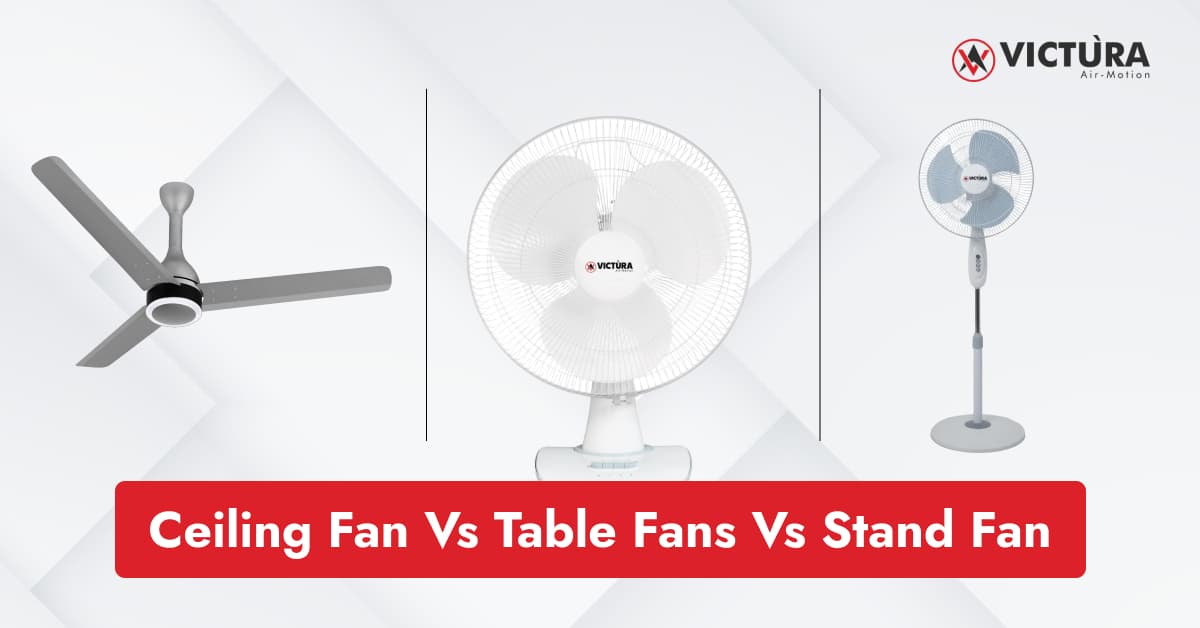
Let’s look at the three common types of fans found in Indian households and compare their average power consumption:
Ceiling fans are the primary cooling devices in Indian homes. They move air all around the room. Yet old ceiling fans don't save much power unless you move to new tech like BLDC motors. A low power consumption fan can save you more than half of your power use.
Table fans work well for direct air. They are often set at desks or work spots and can be moved with ease. They use less power than ceiling fans and cool just the spots you want, saving energy when used right.
Stand fans are like the free roamers of the world. They can change their height, swing side to side, and work well for mid-sized rooms. In terms of strength, they sit between the desk and the ceiling fans. How much power they need depends on their speed, the quality of their motors, and how long you run them each day.
| Fan Type | Wattage Range | Efficient Models | Coverage Area | Typical Daily Use |
| Ceiling Fan | 60–80W | 28–40W (BLDC) | Entire Room | 10–16 hours |
| Table Fan | 40–55W | ~35W | Personal | 2–6 hours |
| Stand Fan | 50–75W | ~45W | Medium Room | 4–8 hours |
It’s not just the type of fan that matters; it’s also how and where it’s used. Here are the main factors that affect power usage:
Older fans with induction motors are less efficient. Modern fans with BLDC motors offer a major upgrade, using up to 65% less power.
Higher speeds = more power. Fans running on “high” all day will naturally consume more electricity than those on medium or low.
Larger blades push more air but may require more power. Plastic blades are lighter, thus more efficient, but may not be as durable as metal ones.
A fan’s efficiency isn’t just about how much electricity it uses — it’s also about how much air it moves. This is measured in Cubic Feet per Minute (CFM). Higher CFM per watt is better.
If you use a big ceiling fan in a small room or place a fan far from you, the energy isn't used well.
Fans with dirty blades, blocked motor vents, or bad wiring use too much power and don't work well.
Here’s a story.
Rahul and Neha had just moved into their first home in Bengaluru. With the heat creeping in and a tight monthly budget, they decided to furnish smartly. Instead of splurging on an AC, they invested in a combo, one BLDC power saving fan for the bedroom, one energy-efficient table fan for their work-from-home setup, and a stand fan for the living room that doubled up as a dryer for clothes on rainy days.
Their bill? Nearly 40% lower than their previous apartment. What changed wasn’t the number of fans, but how thoughtfully they were chosen.
If you’re looking to do the same, here are some tips:
They cost slightly more upfront, but the energy savings (and quieter operation) pay off in a year or less.
BEE star ratings in India are a good indicator of power efficiency. Go for 5-star if possible.
Scheduled usage means less wastage, especially during sleep.
Dust the blades, service the motor, and check for noise. A well-kept fan not only runs longer but runs cheaper.
We often chase big solutions for our comfort: bigger homes, bigger ACs, bigger budgets. But sometimes, small choices offer the biggest returns. Choosing the right ceiling fan power consumption, understanding its energy efficiency, and using it smartly is a step toward energy mindfulness.
In a time when climate change is real and every unit of power saved matters, this isn’t just about bills anymore — it’s about responsibility. You’re not just cooling yourself; you’re cooling the planet down, one watt at a time.
Not often. Table fans use less power than big ceiling fans, but they cool a smaller spot. If you want it just for you, they're good at saving power, but for big spaces, ceiling fans are better.
It depends. Usual stand-up fans may use a bit less or the same power as old ceiling fans. But, new ceiling fans with BLDC motors save much more energy than most stand-up fans.
On average, both use about 50W-75W, but ceiling fans cover more area. So, stand-up fans might look good, but ceiling fans are best for moving air in a full room.
Not always. Old ceiling fans (60W-80W) might use more power than table or stand-up fans. But, new BLDC ceiling fans use as little as 28W, which saves more energy as time goes on.
A table fan using 50 watts for 24 hours takes 1.2 units of power (50W x 24h ÷ 1000 = 1.2 kWh). At ₹8 per unit, it costs about ₹9.60 each day.
Stand-up fans are easy to move and can fit many needs, but they: Cover less area than ceiling fans; Take up space on the floor and can be big; Can make a lot of noise at high speeds; Are less steady and might fall over if not set right.
Keep moving with bright ideas. From the way air moves to clever home hints, our blog is your place to dive into ease, style, and smart energy use.