Choosing the right exhaust fan wattage helps balance effective air circulation with lower energy usage across indoor environments.
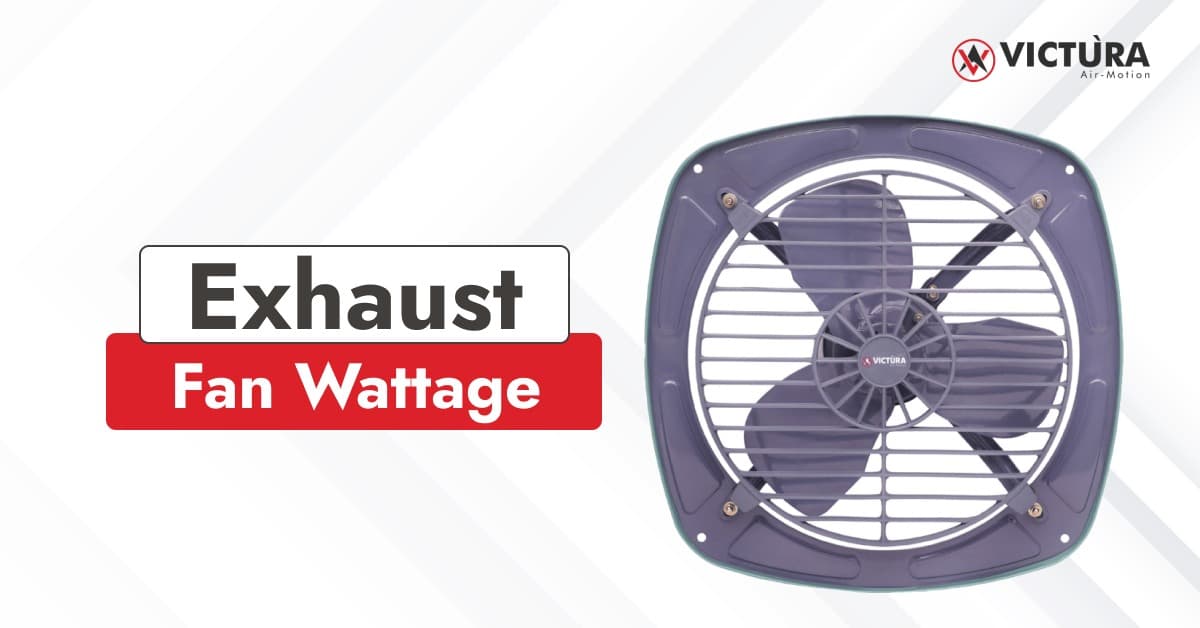
Exhaust fan wattage makes a lot of difference. On a mid-day summer visit to an average Indian kitchen, you will find the exhaust fan running and can hear the everlasting buzz of the fan as it is the one that is taking away the smoke, grease, and hot air, so you can breathe a little easier while stirring that curry.
But have you ever wondered how much power the fan is actually using?
Wattage is the point where things come together. The wattage not only decides the power of the exhaust fan but also how much of your monthly electricity bill it is going to make. In case you want to balance comfort with cost-saving, it becomes necessary to pick out the energy-efficient exhaust fan.
We are going to unpack the meaning of exhaust fan wattage, the importance of it, and how to pick the right one for your home or office without spending a lot on power through this master class.
Wattage can be considered the "appetite" of your exhaust fan. It indicates the amount of electric energy consumed by the fan while it is in operation.
However, this is the catch: more wattage is not always a sign of better performance. The most important factor is how a fan is able to move the air volume that corresponds to the energy it consumes. This is the aspect where energy efficiency plays a role.
Imagine you have two exhaust fans:
One is Fan A, whose wattage is 60 and air flow is 400 m³/h.
Next is Fan B, which takes up 40W and gives 400 m³/h in air delivery.
Both fans can do the same work. However, Fan B is more efficient—it provides the same airflow at a lower electricity consumption. That difference, over time, becomes significant, especially if the fan is running every day.
Therefore, when you are looking for an exhaust fan, wattage alone is not helpful. You must find out the airflow, measured in CFM (cubic feet per minute or m³/h), that the fan can deliver per energy unit.
Manufacturers, in their communication, often refer to the fan exhaust performance in that capacity and power as follows:
If a fan’s efficiency is to be measured, the power that the fan takes should be divided by the air flow rate. In this manner, one would find the amount of air moved for every watt of energy used.
The right wattage for your exhaust fan depends on where you’re installing it.
One of the common misunderstandings is that a higher power output will always bring quicker results. Although this may be partly correct, it is somewhat comparable to the situation of a 100-watt fan being used while a 40-watt one could do the job.
We can verify this with a simple calculation:
Now compare with a 40-watt efficient fan:
It may look small, but over the years, and with multiple fans running in your home or workspace, the savings pile up.
Choosing an energy-efficient exhaust fan isn’t just about low wattage. Look for these features:
1. BLDC Motor Technology: The power consumption is reduced by 50-70% as compared to traditional motors.
2. Aerodynamic Blades: The blades are designed to go through the air with minimal resistance, which saves the air flow efficiency.
3. Timers & Sensors: They make a fan run only when it is necessary, thus no electricity is wasted.
4. Noise Reduction Design: A quiet fan is usually a sign of a well-functioning, optimized (and hence, less energy is wasted) system.
5. Star Ratings: In case they exist, consider certified ratings like the Bureau of Energy Efficiency (BEE) or any other similar certification in your country.
Here’s a simple step-by-step approach:
1. Measure the Room Size: Bigger rooms need higher airflow.
2. Check Airflow Requirement: Kitchens usually need 10–12 air changes per hour, bathrooms around 8–10.
3. Match Wattage to Need: Don’t overshoot. A bathroom doesn’t need a kitchen-grade fan.
4. Look Beyond Wattage: Focus on airflow efficiency (CFM per watt).
5. Consider Smart Features: BLDC motors, timers, and sensors will pay for themselves over time.
The next wave of exhaust fans is all about smart efficiency. We’re seeing models that connect to apps, adjust speed based on room conditions, and integrate with smart homes.
Exhaust fan wattage is a significant factor, but it is just one feature of the whole saga.
The wiser move would be to seek out the fan that would offer you the maximum air flow with the minimum power consumption.
It doesn’t matter if it is your kitchen, bathroom, or office; an appropriate energy-efficient exhaust fan will give you fresher air, lower your bills, and provide you with the silent pleasure of knowing that you are doing your share for the earth. Designs such as those from Victura Airmotion reflect this approach by focusing on efficient airflow, reduced power consumption, and quieter operation for everyday spaces.
Exhaust fans work to make air quality better by removing smoke, bad odors, moisture, and heat. Therefore, it’s needed in rooms like kitchens, bathrooms, or even for commercial purposes, like factories.
Not really. As it is not an AC and doesn’t cool the air, removing the hot air and increasing the airflow can still make the room less stuffy and comfortable.
In the case of Indian kitchens where there is a lot of smoke and oil, a chimney is more efficient for your health and ozone. If you only want to ventilate and eliminate the smell, an exhaust fan would be a more comfortable and cheaper alternative.
A 12 inch exhaust fan wattage is around 40–60. Maybe a little more or less, depending on the model and brand.
Yes, it can, but be warned that the more it runs, the faster it will get worn out. The best practice is to let it run only when necessary.
The exhaust fan wattage is 15–30 for small ones, 35–70 for medium sized ones, and 80–300 for industrial grade ones.
Keep moving with bright ideas. From the way air moves to clever home hints, our blog is your place to dive into ease, style, and smart energy use.