Learn why copper winding in ceiling fans matters for better airflow, energy efficiency, quieter operation, and longer motor life before you buy your next fan.
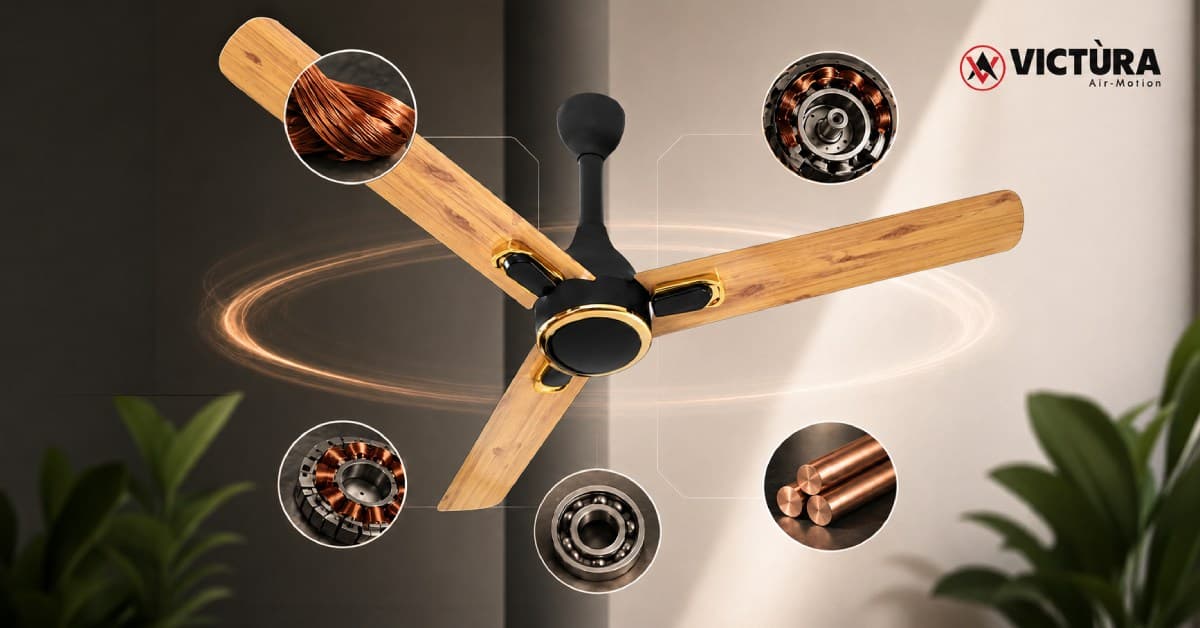
The actual power of a ceiling fan is concealed deep in the copper winding ceiling fan motor. The motor's material determines all the smooth spins, steady breezes, and quiet nights. One of the most important and at the same time overlooked components is copper winding in ceiling fans.
While it is seldom seen or talked about during purchase, it has a decisive influence on the efficiency of a fan and its lifetime. Knowing copper winding helps you comprehend the reason why some fans are dependable year after year, while others have a hard time early on.
This tiny detail silently determines comfort, performance, and long-term value.
Let’s take a look at what the copper winding ceiling fan does:
The motion of the ceiling fan comes from rotation, yet it is the internal coil that supplies sustained energy. Though blades move air, hidden circuits drive the rhythm beneath.
Circling the motor's center, layered bands of pure copper form the winding. Where electricity flows, a field emerges, shaping movement within the machine. Motion begins not by force, but by an invisible push beneath the coils.
Why use copper?
It is quite straightforward, copper has the highest conductivity among all metals. The lower the resistance, the more:
That is why the copper winding ceiling fan does not have any difficulties starting or slowing down when overloaded. They react very fast to the changes in regulation, particularly in situations of voltage variations or even power outages, and this reaction is so clear that it can be easily sensed.
Simply put, copper takes away the burden from the motor and makes it operate with greater efficiency.
A frequent misunderstanding suggests that rapid blade rotation guarantees improved air movement. Actually, steady motor torque output determines how well airflow is maintained.
Copper-wound motors maintain steady magnetic strength. That stability allows the fan to:
This is why two fans with the same blade size and RPM can feel completely different in real life.
With copper winding, airflow doesn’t fade after months of use. It stays reliable—whether it’s the first summer or the fifth.
You don’t just see the fan spinning. You feel the difference in the room.
Heat is the invisible foe of electrical gadgets.
An electric motor that is excessively heated:
Copper's resistance is less and thus it does not generate much heat in the course of operation. Even after a long period, like those hot summer afternoons. Thus, copper-wound motors remain cooler.
This has two big effects:
That’s why a copper winding ceiling fan often lasts for years with minimal issues, while cheaper alternatives start making noise, losing speed, or burning out prematurely.
Durability isn’t magic. Its materials are doing their job properly.
Most people talk about energy efficiency only when bills spike.
But the truth is, efficiency isn’t about dramatic savings overnight; it’s about quiet consistency.
Copper winding improves efficiency by:
Over months and years, this adds up. A copper winding ceiling fan:
You don’t need to calculate units or monitor usage obsessively. The savings happen naturally, simply because the motor wastes less energy doing the same job.
It’s efficiency that works in the background, just like a good fan should.
With newer motor technologies entering the market, some people assume winding material doesn’t matter anymore. That’s not true.
Even when considering older models or newer versions built for lower power use, wiring made of copper continues to play an essential role due to its ability to carry current reliably because it:
Even advanced fans rely on copper for stability and longevity. Technology may evolve, but physics doesn’t change.
Good winding ensures that innovation actually performs well, not just on paper, but in daily life.
Here’s a small but practical checklist:
When clarity exists around material sourcing, trust often follows. A company that shares openly tends to inspire confidence simply by doing so.
Copper winding ceiling fan is probably invisible but its influence is nonetheless felt all the time.
It allows more or less invisible but always considerable air flow through the ceiling fan, which makes it cooler, causes less energy to be wasted and thus prolongs the life of the fan without actually having to pay attention to it.
In a home where fans operate for hours year-round, this concealed aspect turns out to be a long-term benefit as opposed to a technical extra. Having a copper winding ceiling fan is not a matter of trying to get features; it is a matter of selecting reliability, efficiency, and tranquility.
So, get Victura Airmotion fans for your home that give you performance that remains constant over time.
The copper wire is the part of the motor that is wound and it leads the electric current that creates the magnetic field which is necessary to rotate the fan. The copper wire then directly determines the run of the fan in terms of being smooth and efficient.
The main reason for using copper is its perfect conductivity of electricity. If the electricity flows through a copper wire, it will produce less heat and therefore, the motor will be capable of operating without any strain for long hours with reliability.
Indeed, copper winding will give you lower resistance, superior heat management, and an increased lifespan of the motor when compared to aluminium winding.
It would be right to say that the answer is yes, but in an indirect way. The use of copper winding in the fan minimizes the electrical power loss, thus it will always require a power supply that is comparatively less than that of the fan produced using aluminum winding.
Manufacturers generally mention the copper winding explicitly by putting “100% copper winding” in the product specifications or warranty information.
Copper winding motors are usually smoother and quieter due to stable current flow and less overheating, so the answer is yes.
Keep moving with bright ideas. From the way air moves to clever home hints, our blog is your place to dive into ease, style, and smart energy use.