Explore the ceiling fan sizes guide for 2026. Find the right fan size for your room, compare measurements in mm and inches, and learn how to measure a ceiling fan.
Choosing the correct ceiling fan size can improve your level of comfort and airflow noticeably. Taking room dimensions first and getting fan dimensions will help you purchase a good and efficient size fan, which can perform equally through the year.
What if the ceiling fan size is too small to deliver satisfactory ventilation, or it is too big and delivers too much airflow for your space?
In our 2026 ceiling fan sizes guide, you’ll discover how to determine what size fan is best suited for your living room size, get to know millimetre & imperial measurements and learn to measure ceiling fans.
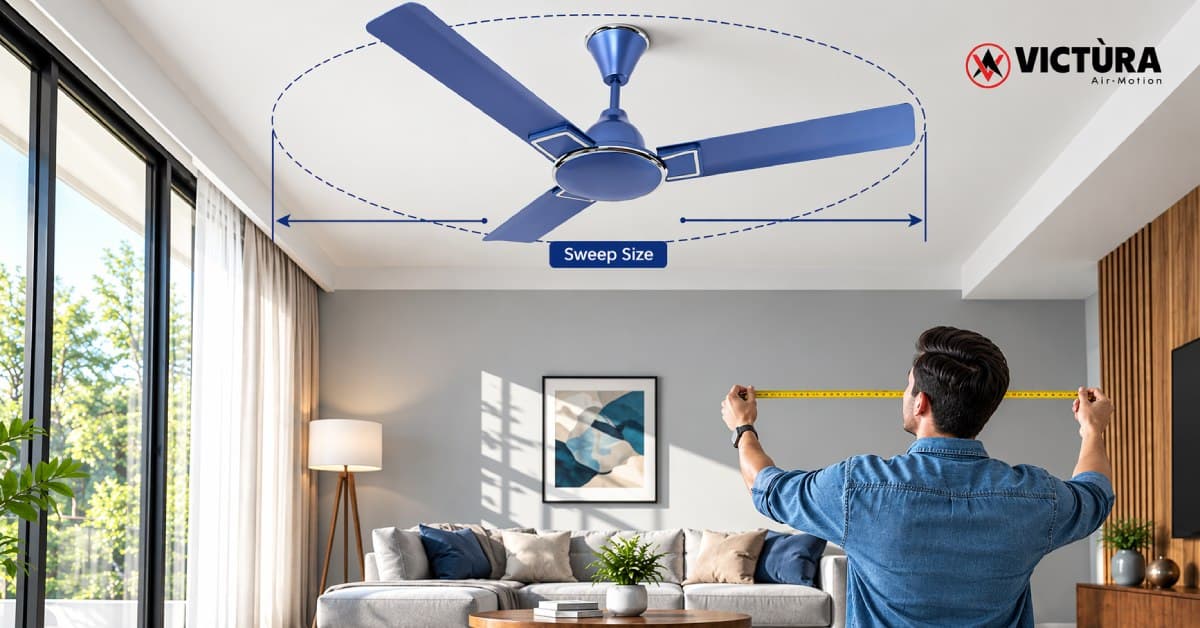
The size of the fan means the diameter of the circle traced by the ceiling fan blade size or the sweep as they rotate.
In India, you can find ceiling fan sizes in inches and in mm, and sometimes they are also expressed by the manufacturers in inches.
For example:
The normal ceiling fan size for bedrooms and medium rooms will normally be around 1200 mm.
The quickest fan option that you have is if the size of the fan's sweep matches your room size, with not too much overlap, you’ve arrived.
| Room Size | Recommended Fan Size | Approx. Size in Inches |
| Up to 50 sq. ft. | 600–900 mm | 24–36 inches |
| 50–75 sq. ft. | 900–1050 mm | 36–42 inches |
| 75–120 sq. ft. | 1050–1200 mm | 42–48 inches |
| 120–180 sq. ft. | 1200–1400 mm | 48–56 inches |
| Above 180 sq. ft. | 1400–1500+ mm | 56–60+ inches |
These are guidelines and not rules. The size, shape, ceiling heights, the arrangement of the room along with how good the motor of your fan is, all need to be taken into account.
If you want to know a ceiling fan’s size but you have already installed it, then below are the steps.
Don’t try to measure any moving parts with the help of a measuring scale and also remember to switch off the fan.
The radius of the ceiling fan will be decided by measuring it from the center of the fan to the tip of the blade.
You’ll need to double the calculated value to ascertain the diameter value of the ceiling fan size.
Let’s suppose that the measurement from the center to the end of the blade is approximately 600 mm as seen. Then you will have to double the value as
600 × 2 = 1200 mm
So, the fan has a sweep of approximately 1200 mm, or 48 inches.
This is the basic method for understanding how to measure ceiling fan size.
The ceiling fan diameter room size are important for several reasons. The larger the diameter of the ceiling fan, the larger the amount of air will be thrown from the blades across a much larger area.
For a small bedroom, small study, small kitchen and a small office, a ceiling fan small size can still offer a considerable amount of airflow for the floor space of your room.
A large bedroom, hall and lounge area will need to have a larger sweep on it.
If a room happens to be quite long, or rather an unusual shape, then it may be worth looking at whether one fan will be sufficient or even two smaller fans.
The ceiling fan blade size determines the fan’s sweep, but bigger blades do not automatically mean better performance.
Consider:
A larger fan with an efficient motor can move air across a bigger area, while a compact fan may be better suited to smaller rooms.
Ceiling fan bearing size is different from the overall fan size. Bearings are components inside the motor that help the shaft rotate smoothly.
For buyers, bearing quality and motor construction are generally more important than simply looking for a larger bearing. A well-built motor can contribute to smoother, quieter, and more reliable operation.
The ceiling fan rod size refers to the downrod that connects the fan motor to the ceiling mount. Its required length depends mainly on your ceiling height.
For standard-height ceilings, a regular downrod may be sufficient. Higher ceilings may require a longer rod so that the fan hangs at a suitable height for effective airflow.
Always follow the manufacturer’s recommended installation height and downrod options.
A ceiling fan small size can be a practical choice for compact spaces where a standard 1200 mm fan would be too large.
Small fans can work well in:
The ceiling fan small size price also varies depending on motor technology, energy efficiency, design, brand, and features. Instead of choosing solely based on ceiling fan price small size, compare airflow, power consumption, warranty, and build quality.
Before making any purchases, measure your room, review the recommended ceiling fan sizes by the manufacturer and finally, determine how the sweep matches with the space on your ceiling.
Select a smaller fan when working with a smaller room, as you might believe that " Bigger means more". Measure the room before choosing the fan. Check ceiling fan size in mm as well as inches. Use the ceiling fan size chart as a starting point.
Match fan size to the room size. Your room ceiling height should play a role when choosing the rod. Do not just measure the size of the blade size; check for the size of the motor and its airflow function. Do not buy a larger fan for a small room, believing bigger is always better.
A normal fan size that you can usually choose from for a medium size room or bedroom is 1200mm (48 inches), which of course, depends on room measurements.
Measure the length and width of your room, multiply them to obtain your room area, then find your size from the ceiling fan size chart. Room height and layout are also considered.
A 1200 mm fan is suitable for an average size room, whereas 1400mm is good for larger areas to circulate the air as much as possible.
Just multiply the length from the tip of any one blade of the fan to its center point by 2 in inches. This will provide you with the overall diameter of the ceiling fan.
In the case of a small room, about a 24 to 36-inch, or the 600mm to 900mm fan, typically works best. The size of the room should match the product's described coverage. Always examine the room plan too.
Ceiling height determines the mounting hardware required (especially the downrod length), how safe it is to install the fan and efficiency; therefore, a fan size must go with high or low ceilings.
Keep moving with bright ideas. From the way air moves to clever home hints, our blog is your place to dive into ease, style, and smart energy use.