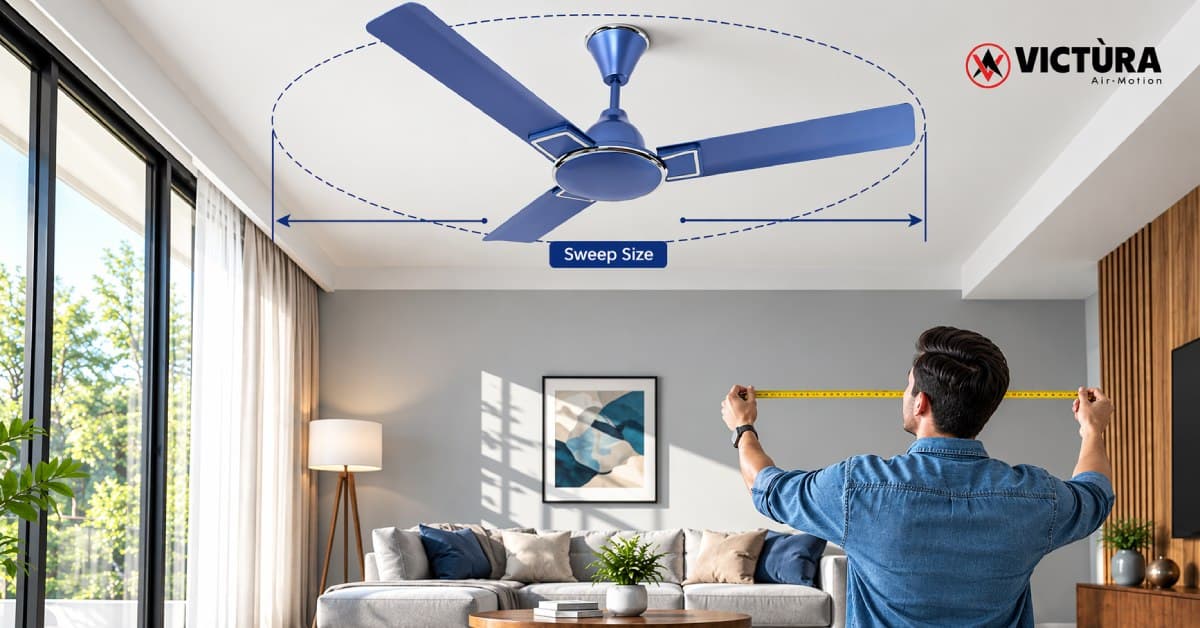
Calculate ceiling fan power consumption, electricity units and monthly cost. Compare normal vs BLDC fans and discover how to reduce electricity bills.
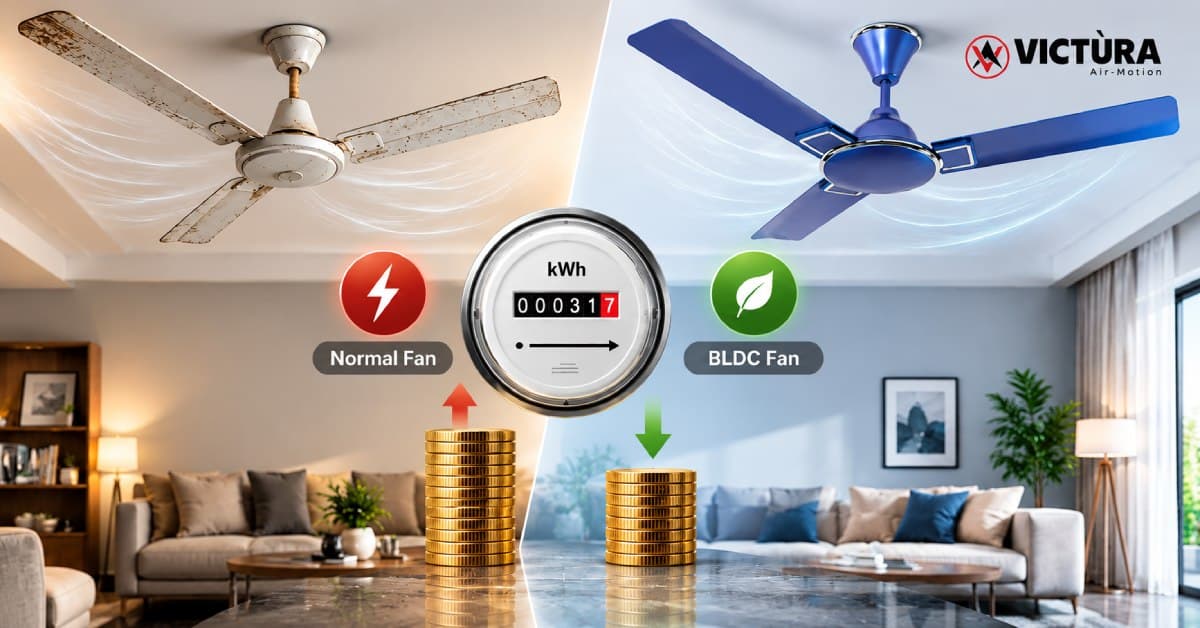
Ever thought about what is the power consumption of a ceiling fan or how much does it actually cost to run?
When the scorching summer comes, you’re barely thinking of the electricity meter.
Come the end of the month and you ask: how much power does a ceiling fan consume, and what is its cost? It depends on watts, time it’s used and if it has an old induction motor or a modern BLDC motor.
Let’s compare normal fans and BLDC fans, and learn how to calculate ceiling fan power consumption, estimate units consumed, and its cost.
Power consumption is focused on electricity. It’s about how many watts is a ceiling fan. It’s like how much food a person can eat. But instead of food, a fan eats watts. And watts are like calories for a fan.
For a standard fan, optimal wattage is 60-80 watts. But for BLDC fans, it can be lower, around 28-35W. How much power a fan takes up in one hour is measured in kilowatt-hours (kWh), commonly called units.
So, for a standard 70-watt fan running for one hour, its ceiling fan power consumption per hour will be 0.07 kWh. Let’s check out how we measured this.
An electrical fan can be estimated with the following formula:
Electricity consumed(units) = (Fan Wattage x No of hours run) / 1000
Now to find electricity cost:
Electricity Cost = Electricity Consumed x Electricity tariff per unit.
Example: 70 W Normal Fan
Let's take an example: The fan wattage used is 70W and it is run for 8 hrs every day.
Daily consumption:
70 × 8 ÷ 1000 = 0.56 units/day
Monthly consumption:
0.56 × 30 = 16.8 units/month
If your electricity rate is ₹8 per unit:
16.8 × ₹8 = ₹134.40 per month
This is an illustrative calculation for how much unit of electricity consumed by fan. Based on your energy tariff, taxes, fixed charges and usage of other devices at home, your actual price might vary accordingly.
The usage of units varies as per the wattage of the fan, number of hours and the number of appliances you use in your room or your home.
| Fan Power | 4 Hours/Day | 8 Hours/Day | 12 Hours/Day |
| 40W | 4.8 units/month | 9.6 units/month | 14.4 units/month |
| 50W | 6 units/month | 12 units/month | 18 units/month |
| 60W | 7.2 units/month | 14.4 units/month | 21.6 units/month |
| 70W | 8.4 units/month | 16.8 units/month | 25.2 units/month |
| 80W | 9.6 units/month | 19.2 units/month | 28.8 units/month |
The figures assume 30 days of operation and continuous running at the stated wattage.
This table makes it easier to understand how much power consumption for ceiling fan you can expect based on your daily usage.
The biggest difference between conventional and BLDC fans is the motor technology.
A conventional ceiling fan generally uses an induction motor. A BLDC fan uses a brushless DC motor designed to deliver similar airflow with significantly lower electrical consumption.
Consider two fans:
70 × 8 × 30 ÷ 1000 = 16.8 units/month
Estimated cost:
16.8 × ₹8 = ₹134.40/month
35 × 8 × 30 ÷ 1000 = 8.4 units/month
Estimated cost:
8.4 × ₹8 = ₹67.20/month
In this example, the BLDC fan uses about 8.4 fewer units per month, resulting in approximately ₹67.20 monthly savings on fan electricity consumption.
If several fans operate for long hours every day, the difference can become much more noticeable over a year.
A 5 star ceiling fan power consumption rating is associated with operating power of 35W, then use 35W value in calculator:
35 × hours of use ÷ 1000 = units consumed
Remember that measured operating energy may differ at higher fan speeds and in different circumstances. Running a fan at highest speeds may consume more energy than when operating on lower settings.
A simplified formula is:
Current (Amps) = Power (Watts) ÷ Voltage (Volts)
For example, a 70W fan operating at approximately 230V would have a theoretical current of:
70 ÷ 230 ≈ 0.30 A
Actual ceiling fan current consumption can differ because motor efficiency and power factor also affect electrical characteristics.
When it comes to everyday electricity usage estimates, wattage is usually more relevant than current since that’s how they consume electricity: by generating power over time.
For an estimation of the power consumption of a fan, use the following steps:
Examine the casing, the fan motor or the product specifications of the fan or ceiling fan that may also list fan wattage.
Multiply that by the total hours you use each day.
Use:
Wattage × Daily hours ÷ 1000
Multiply the daily consumption by the number of days the fan operates.
For instance, a 50W fan running 10 hours daily:
50 × 10 ÷ 1000 = 0.5 units/day
Over 30 days:
0.5 × 30 = 15 units/month
At ₹8 per unit:
15 × ₹8 = ₹120/month
It’s a quick and simple way to give you an idea about ceiling fan electricity consumption.
A few hours of daily running ceiling fans would make you reconsider energy consumption.
When replacing an old fan, compare wattage rather than looking only at the design or price, look for its wattage.
A low power consumption ceiling fan, particularly a BLDC model, can use substantially less electricity.
No matter the situation, you are not required to keep the fan running on highest speed. Use the comfort setting as you deem fit depending on air quality needed.
The dust present in the fan blade and motor also hinders the flow of air in the room. The dusting can also maintain optimum performance.
Selecting a fan that best fits into the room can lead to efficient flow of air. The size is also necessary to maintain comfort and quality of the air in room.
The fan also consumes electricity the moment it turned on. Switch it off when you leave the room empty.
If you know the ceiling fan power consumption, you will be able to get an idea of your electricity bills every month. This will also aid you in selecting energy-efficient ceiling fans in the future.
Never choose a fan solely by the wattage, though. Look at factors like airflow, fan size, the quality of the motor, warranty and building material, and the fan's cost.
You could install highly efficient fans for truly low ceiling fan electricity consumption.
Standard fans range between 60-80W, whereas energy efficient BLDC fans consume between 25 to 40W.
A 70W fan consumes approximately 0.07 units per hour whereas a 35W fan consumes 0.035 units in one hour.
Calculate consumption by using this formula: Wattage × Hours Used × 1,000 = Electricity Units Consumed.
Yes. In general BLDC ceiling fan consumes less power in comparison to induction motor fans offering same airflow.
Opt for energy efficient or BLDC fan, set the proper speed on the fan, clean the blades timely, buy the right fan size, and switch off the fan when not required.
Sure, it is! It helps to save a lot of power, especially if your home has a lot of fans running in different rooms.
Keep moving with bright ideas. From the way air moves to clever home hints, our blog is your place to dive into ease, style, and smart energy use.