Explore the benefits of remote control ceiling fans, from easy operation and comfort to energy-saving BLDC technology.
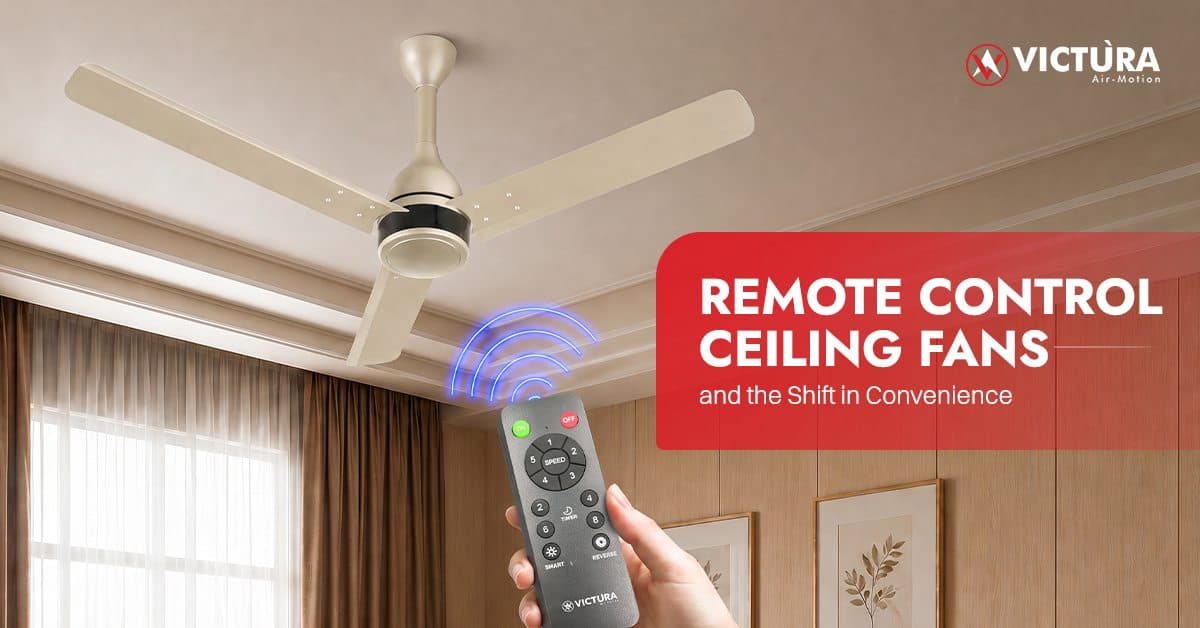
Remote control ceiling fans follow the principle of convenience as its primary design guideline. Our current expectation requires all basic home amenities to provide us with comfort through their automatic adaptation, instead of making us adjust to their operation.
The design of ceiling fans, which used to be operated through pull cords and wall regulators, has transformed to match current consumer requirements. Remote control ceiling fans serve as more than a simple technology enhancement because they demonstrate how modern homes are developing towards maintenance-free operation.
The fans introduce a new level of comfort which enables users to control fan speed and airflow and all other fan functions from any position within the space. As people become more occupied with their daily activities, and as residential technology becomes more advanced, the need for convenience has transformed into a standard requirement.
The smart technology development process for ceiling fans started through the evolution of ceiling fan equipment. Ceiling fans operate as practical devices which serve their purpose to generate airflow while they cool spaces and maintain their operational efficiency.
The introduction of intelligent household devices which include televisions and light fixtures and air conditioning systems brought about a need for people to redesign ceiling fans.
The development of the ceiling fan with remote control brought about that transformation. Control systems which were previously dedicated to one wall location now gave users the ability to operate their devices from anywhere in the room.
Users could now control their devices from any location because they gained access to speed and power and timer and directional settings. The transition period from ceiling fans being basic appliances to advanced user-friendly products began with this transformation.
The appeal of remote control ceiling fans lies in how naturally they fit into daily routines.
People experience comfort when their activities face no disruptions.
After a long workday, you should picture yourself resting. The fan speed feels slightly high, but the idea of getting up feels worse. The remote control system enables users to make adjustments with great ease. The tiny moment which people experience now will accumulate through the passage of time.
The product functions effectively in actual home environments.
The design of modern homes follows two common patterns which include people who need dual door access to their main entrance and people who need special support through their main entrance. Remote control fans solve this by removing dependence on fixed controls altogether.
The system works best in bedrooms and homes that need design features for elderly people.
Remote control fans provide a major benefit for bedrooms that people use during nighttime. Sleep quality improves when people can modify airflow without waking sleeping partners. The system provides elderly users and people with mobility problems with two main benefits which include comfort and accessibility.
Remote control ceiling fans often go hand-in-hand with BLDC motor technology. This pairing has accelerated their adoption.
BLDC ceiling fan with remote enables complete electronic control over its rotational speed and energy usage. That’s why remote commands respond instantly and consistently. Beyond convenience, BLDC motors consume significantly less electricity than traditional induction motors, making these fans both smart and economical.
The result is a product that aligns with two modern priorities: comfort and conscious energy use. The developed product meets current market demands because it provides users with both comfort and energy-efficient solutions.
The system has been developed to operate with data that extends until October 2023. Remote control ceiling fans go beyond their basic function of turning the fan on and off. The features have developed over time because they need to meet the changing demands of everyday life.
The basic appliance transforms into a dynamic system that interacts with the home environment through these specific functions.
The design of remote control ceiling fans has become more popular because of their aesthetic appeal. The design maintains wall cleanliness because it eliminates the need for large regulators and visible electrical wiring.
The fans have undergone design changes which resulted in more streamlined blades, matte surface finishes and smaller motor housing designs. Remote control fans provide modern interior spaces with a design element that functions as an integrated part of the space instead of creating a noticeable presence.
The traditional regulators require manual adjustments, which results in their components experiencing wear. The implementation of remote-controlled systems decreases the mechanical workload, which results in improved operational performance throughout the system's lifespan.
The combination of BLDC motors, which operate at lower temperatures and produce less sound results in extended fan lifespan and stable operational performance.
The development of remote control ceiling fans introduces an unnoticeable transformation that alters our expectations about how homes should function. Appliances now function as active devices that we expect to learn our needs and operate automatically without requiring user intervention.
The present shopping behavior across various home product categories derives from the convenience that design developers embed into their products. The development of ceiling fans represents the complete product transformation that customers now expect.
People now control their room temperature through remote ceiling fans which represent a major change in how people use their home environments. The appliance now functions as an interactive home element that people can operate from their houses through its design that prioritizes user comfort, accessibility and operational simplicity.
The system meets contemporary standards because it enables users to direct airflow through stationary operation while using energy-saving features and maintaining an attractive design. The evolution is not about luxury but instead aims for increased efficiency.
So, use remote control ceiling fans from Victura Airmotion and elevate your daily comfort.
The typical ceiling fan operates through an induction motor while the BLDC fan employs a brushless DC motor which delivers reduced energy consumption and produces less noise and enables complete control over its operational speed.
The ceiling fan operates through remote control because it contains an electronic receiver that detects signals from a remote control device to enable users to manage fan speed, power status and different operational modes.
The remote control device allows you to operate the fan by turning it on or off, changing its speed, activating the timer or sleep modes and selecting different airflow options.
The remote control ceiling fans provide users with simple operation, which improves their ability to reach controls while maintaining clean wall appearances and delivering silent operation and superior comfort which benefits bedroom environments.
The regulator system requires users to modify fan settings from a designated location while remote control systems permit users to operate fans from any position inside their space.
All remote control ceiling fans require a wall switch to receive power whereas users control all speed and operational settings through the remote control.
Keep moving with bright ideas. From the way air moves to clever home hints, our blog is your place to dive into ease, style, and smart energy use.