Learn why surge protection is important in BLDC fans and how it protects against voltage fluctuations, inverter issues, and power surges.
A BLDC fan might appear uncomplicated to the outside observer, but it carries inside complicated electronics that need stable power to work reliably.
In Indian households, where voltage fluctuations, sudden power cuts, and inverter switching are everyday happenings, this stability is not guaranteed at all times. This is exactly the moment when surge protection silently comes into the picture.
Most times disregarded, surge protection is nonetheless the main factor keeping the fan's controller safe, thus providing good performance and durability over time.
Knowing the operation of surge protection and its importance enables you to select a more intelligent and future-proof option while buying a BLDC fan.
India's electricity system is seldom consistent. Various causes, such as storms, sudden shifts in power demand, transformer malfunction, or repeated power interruptions and immediate restoration, cause the voltage to increase.
The duration of these variations is usually in milliseconds, but they are still powerful enough to cause the failure of electronic parts. The mechanical aspect dominates the traditional induction fans considerably. What one might call 'fan' tradition. But BLDC fans are distinct in this sense.
They are dependent on electronic control boards, which convert the AC power into DC and adjust the speed of the motor accurately. Efficiency comes with these boards, but that also wreaks havoc.
A single voltage spike will engage in a silent but deadly game, a play of weakening or outright destroying the components if there is no appropriate surge protection installed.
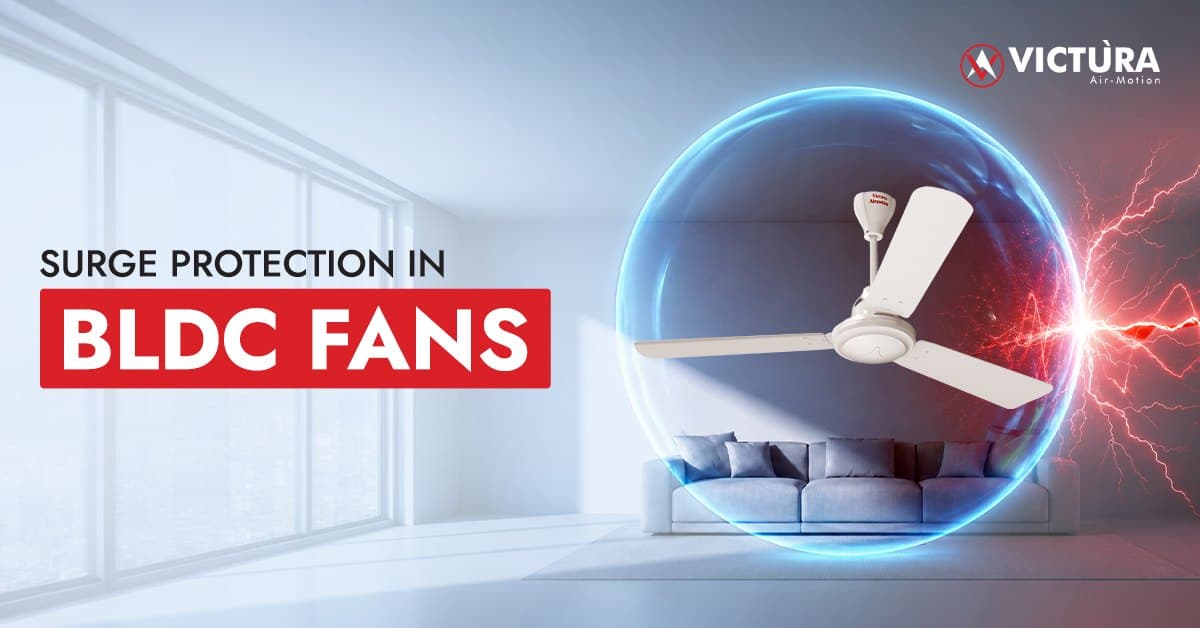
Surge protection is a safety feature that comes built-in and thus protects the internal electronics of the fan from voltage spikes that suddenly occur. It performs the role of a buffer zone: it either absorbs, diverts, or limits the excess electrical energy before it reaches the delicate parts.
In the case of a well-designed BLDC fan surge protector is incorporated at the controller level and it functions automatically. You do not see it, you do not make adjustments to it but it is always on guard.
To illustrate it better, one can say that it is like a shock absorber for the brain of the fan.
A PCB (printed circuit board) that contains microcontrollers, capacitors, and sensors is literally the center of a BLDC fan. These parts function under very narrow voltage ranges. A sudden upsurge can lead to:
Surge protection makes sure that no excess voltage ever reaches these components.
Inverters have become a basic need for a large number of households during power outages. Although BLDC fans are not only inverter compatible but also very low in power consumption, inverters can, however, produce unstable output sometimes, especially those that are of poor quality or overloaded.
A surge-protected BLDC fan is capable of dealing with these inconsistencies better and thus guarantees smooth operation even in the case of frequent power transitions.
Every power cut and restoration cycle carries with it the risk of a surge. The areas where these problems exist are under load shedding, have voltage drops, or are rural supply lines, and they have to contend with this risk daily.
The electronics in such cases may undergo repeated micro-surges gradually, which leads to their early failure. Surge protection helps very much in the case of the fan's life cycle since it defends against this gradual damage.
Regardless of the variations in the designs, the fundamental surge protection functionalities in BLDC fans from various brands are nearly identical:
All of this happens in a split second, usually before you have even detected a power fluctuation.
Victura Airmotion BLDC ceiling fans come with built-in 5 kV surge protection, which effectively secures the internal controller and motor against short-term voltage spikes resulting from inverter switching, unstable supply, and sudden power restoration.
The level of protection provided by this feature guarantees a longer lifespan and fewer breakdowns, which is a very practical benefit in places where there are voltage fluctuations quite often.
The combination of these fans includes energy-efficient BLDC motors, minimal power usage, and inverter compatibility; thus, these are the right choice for contemporary homes that want both performance and long-term reliability.
Surge protector for BLDC fan is not just an optional feature that can be added; it is a safety measure that is built in and considered the main factor that decides the fan's performance in terms of power conditions in the real world.
The fanning power of low wattage and the energy savings seem to be the driving factors, but the actual value lies in the ability of a fan to protect its delicate electronics from voltage spikes and fluctuations.
A BLDC fan protected very well delivers performance that is consistent, breakdowns that are less frequent, and a lifespan that is longer, particularly for households that depend on inverters or are often subject to power cuts.
Eventually, surge protection benefits not only the fan but also your comfort, peace of mind, and investment. So, get Victura Airmotion fans that provide protection up to 5KV.
Surge protection prevents a BLDC fan's internal electronics from experiencing damage caused by sudden voltage spikes by bringing the amount of electrical energy that has the potential to destroy or disrupt the appliances to a bare minimum, and if that is not completely effective, then it will direct them.
Certainly. The power surges can burn or make the controlling board of the ceiling fan weaker, which is mainly the case with BLDC fans that have delicate electronic components and thus the power surges more easily affect them.
The speed and efficiency of BLDC fans are controlled by electronic controllers. Without surge protection, performance could be erratic or failure could happen altogether due to the voltage fluctuations.
Without question, safeguarding against surges regulates fluctuations in the inverter’s output voltage. This contributes to steadier performance when electricity is interrupted or returns. Smooth functioning becomes more likely under such conditions due to stabilized input behavior across transitions.
Some models have surge protection built in. But protection levels change from one brand to another so checking individual fan details on voltage shifts or electrical safeguards becomes necessary. What matters most appears in those numbers.
No way. External stabilizers can help with voltage regulation, but built-in surge protection is faster and that is the reason why it is connected directly to the fan's internal electronics.
Keep moving with bright ideas. From the way air moves to clever home hints, our blog is your place to dive into ease, style, and smart energy use.