What is a BLDC fan? Learn the BLDC full form, how BLDC ceiling fans work, their energy-saving benefits, inverter performance, and why they’re worth it.
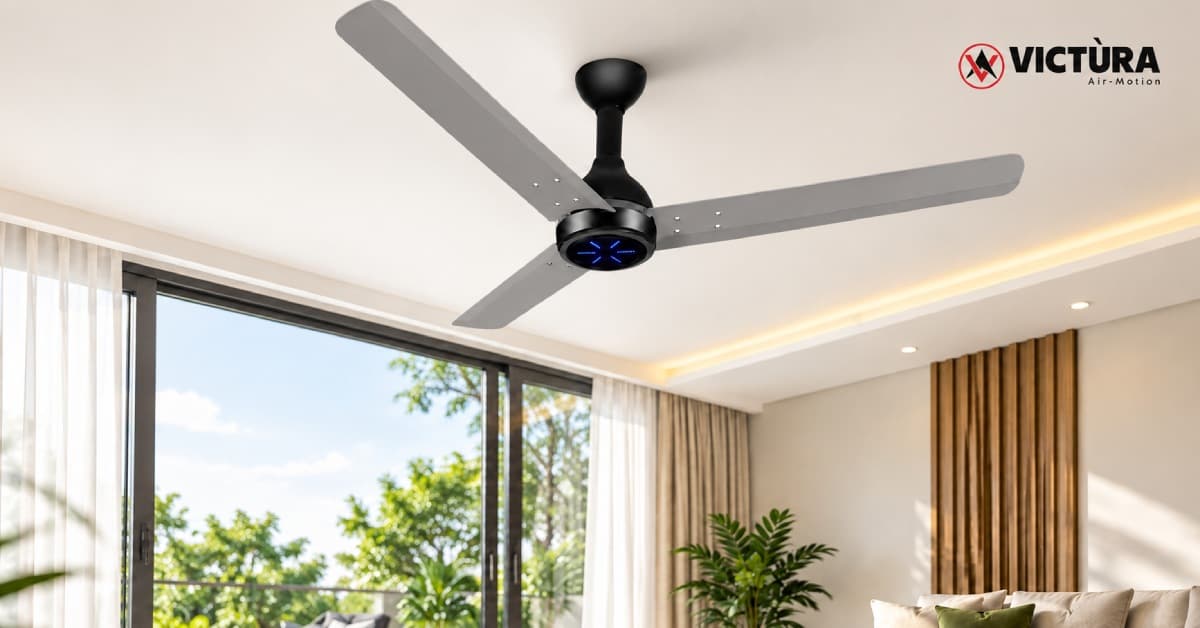
What is BLDC fan? BLDC ceiling fans have been gradually gaining in popularity for the last few years, as they provide cooling at a much lower electricity consumption. They are far more energy efficient than traditional fans, they are quieter and work great on inverters during power cuts.
In most Indian households, ceiling fans are used throughout the year, for 10-15 hours every single day of the year. What most people do not know, however, is that the majority of the traditional ceiling fans they use consume significantly more power than needed.
This is where BLDC Fans have stepped in.
But what is BLDC fan?
Is it a worthwhile investment?
Let us take it step by step in simple terms.
BLDC meaning is Brushless Direct Current.
A BLDC fan uses a Brushless Direct Current motor instead of the conventional induction motor you’d see in the old-style ceiling fans.
So, “brushless” basically means there are no carbon brushes inside.
BLDC motor full form is Brushless Direct Current, a modern take on traditional DC motors. Where older models rely on physical brushes to route power through windings, creating movement, this type skips metal contacts entirely.
Instead, circuitry handles timing and current shifts across coils. Motion emerges without brush friction, thanks to precise electronic coordination behind the scenes.
When these brushes are made of certain materials, friction causes their physical properties to wear off, heat to be generated, and electricity to be lost as energy. The BLDC motor eliminates these inefficiencies.
Currently used in ceiling fans, electric vehicles, industrial machinery, and home appliances due to its better efficiency and power-saving capability.
If you compare it to a normal fan, a BLDC fan is a kind of "smart" fan.
When power gets to the fan, an electronic control takes the input power, switches and drives the motor to give an accurate output signal. This signals continually change in the magnetic field inside the motor and makes the rotor move smoothly.
Compared to the normal fan that uses electromagnetic induction and a mechanical part, BLDC fans utilize smart electronic switching and achieve a more stable and efficient working.
The popularity of BLDC fans is not just a fad. Here are the tangible advantages that make it a logical choice for contemporary homes.
A conventional ceiling fan typically consumes 70-80 watts. A BLDC fan generally consumes 28-35 watts while ensuring similar or even greater airflow.
The energy savings add up to a considerable amount over a year.
Power cuts are still a reality in many households. A BLDC fan, with its low energy consumption, offers significantly more run-time on the inverter back-up compared to a conventional fan.
For instance, while an inverter may run one conventional fan for a specific period of time, it could potentially power multiple BLDC fans for much longer.
Since a ceiling fan runs for many hours in a day, a few watts saved per fan contribute to substantial savings on electricity bills on a yearly basis. For a house with multiple fans, these savings add up significantly.
With time, the hum and vibrations from the conventional motor start to cause disturbance. The BLDC motor is extremely quiet as there are no brushes which can create a grinding or humming sound.
Hence, it becomes an ideal solution for:
Less friction implies less wear and tear. Absence of brushes and lower heat generated from BLDC motors also leads to a longer life as compared to conventional motors.
BLDC fans deliver stable speed even with variable voltage fluctuations and hence the required air flow continues without constant changes.
Lower energy consumption naturally means less demand for electricity. As a result of it, BLDC fans reduce carbon emissions.
| Feature | BLDC Fan | Traditional Fan |
| Motor Type | Brushless DC Motor | Induction Motor |
| Power Consumption | 28–35 Watts | 70–80 Watts |
| Energy Efficiency | High | Moderate |
| Noise Level | Very Low | Higher |
| Inverter Compatibility | Excellent | Average |
| Heat Generation | Minimal | Higher |
| Speed Stability | Better | Moderate |
| Lifespan | Longer | Standard |
| Maintenance | Lower | Higher |
The short answer is yes.
When we consider the cost of the BLDC fan against other fans such as ceiling fans, BLDC fans initially may appear to be a dearer purchase. It should, however, not be considered in light of the purchase price alone.
Consider the frequency of ceiling fan usage:
While certain household appliances may only be used sporadically, ceiling fans are almost always on every day of the year. Small changes to energy consumption on this level of usage can make a real difference in terms of cost savings.
So when you're planning to get an old ceiling fan replaced or trying to make your home a little more energy-efficient, one of the most prudent choices to make is a BLDC ceiling fan.
The savings begin the moment the fan begins to revolve, and over time, add up to a whole lot.
So, what is BLDC fan? A BLDC fan makes use of a Brushless Direct Current motor to reduce wastage of power and increase efficiency to provide an unwavering cooling performance with the use of a fraction of the energy.
Lower power consumption, less noise, better inverter backup, and electricity bill savings are the advantages of BLDC fans that don't run out of juice over time.
In the majority of households, the added initial cost of purchasing a BLDC fan can be recouped within a few years of owning the fan, in the form of reduced energy bills.
Modern alternatives such as the Victura Airmotion BLDC ceiling fan offer, to consumers, a way to enhance their home through energy saving, low noise operation, good airflow and inverter-friendly features.
BLDC fan full form is Brushless Direct Current fan.
BLDC stands for Brushless Direct Current. It's a type of motor technology that employs electrical circuits instead of brushes for smooth and precise control over a BLDC motor's rotation.
Energy efficiency in BLDC fans is achieved through the minimum energy dissipation during motor operation due to low heat generation. The energy wasted from friction between brushes and a motor is eliminated in BLDC fans.
Yes. The power requirement of a BLDC fan is very low, so it can run for a considerably long period when there is a power cut as compared to a conventional ceiling fan.
A BLDC fan can reduce power consumption by 65%.
Keep moving with bright ideas. From the way air moves to clever home hints, our blog is your place to dive into ease, style, and smart energy use.



-1770295331021-949170771.jpeg&w=2048&q=75)
