Firstly, selecting the best height (around 6 to 7 feet) for wall fan installation is very important. Then you should make sure that no objects are obstructing the way and thus creating a clear airflow path.
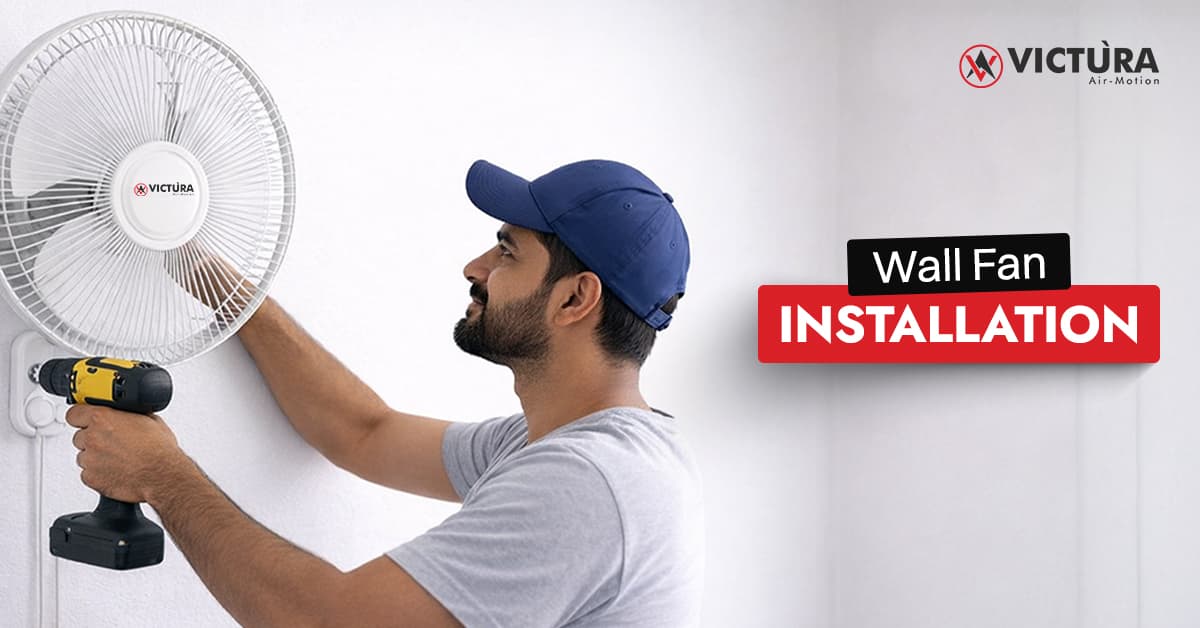
Wall fan installation spot is instrumental in increasing the airflow and cooling a room that can be of the floor space without using it.
However, simply hanging it anywhere is not sufficient! The proper placement of your wall fan is the main thing for the fan to actually make its wonder.
We’ll show you the areas that are most effective from the perfect mounting height to setting up cross-breezes—that convert a simple swirl into the powerful, whole-room circulation.
Stop just moving air around and start achieving maximum cooling efficiency.
An explanation that air should be handled like water was given. If air is directed properly, it is like water that flows smoothly and covers every inch of space. But if the air is blocked, it becomes like water that stagnates in the same place.
Wall fan installation aids air flow across the room horizontally - as opposed to ceiling fans that swirl air vertically. This means that a few inches either up or down, or a wall that is too close, can change the whole airflow path.
Features of a properly placed wall fan are:
Maybe the most decisive factor concerning your wall fan is its height. The installation of the fan should be 6 to 7 feet (approx. 1.8 to 2.1 meters) above the ground.
What's so special about this height? By this height, the fan is far enough from being blocked by furniture or people and still close enough to send the air down and across the free part of the room.
Generally, a single wall fan is capable enough to do the job, but the point of wall fan installation should always be to facilitate the creation of an air movement pathway.
The primary goal is to arrange the fan in such a way that the fan can push air across the room that is, not facing walls or heavy furniture.
It is wrong to have a wall fan that blows directly into people's faces – this is both uncomfortable and ineffective.
The correct height is usually 7 to 8 feet from the floor, a little above eye level. At this height, the air moves freely across the room and doesn't get trapped by furniture.
Where the ceiling is high, the fan should be mounted even higher – around 10 to 12 inches from the ceiling – in order to draw warm air downward and circulate it.
If the fan is mounted centrally on the longest wall, the oscillation can cover the maximum area without the fan hitting a corner or an obstacle immediately.
The air can be better directed towards the floor if a little downward angle is used as the air can travel further before it rises again.
Make sure that there are no big things like tall cabinets, partitions, or pieces of furniture in the direct way of the fan that would block the airflow and thus, the fan's direct path.
Creating a wall fan corner is the most common airflow mistake with the notion of “saving space”.
Basically, when the air stream is directed at two walls that are joined, it slows down and the circulation is weakened. Therefore, it is better to put the fan on a normal wall surface, a wall that is probably opposite a window or a door.
Now, the fan will bring the fresh air in and let the old air out — thus, a natural airflow cycle is created.
The Rule of Flow: There has to be a clear entry and exit for the air.
One side of a room can get air while the other side can still be stagnant. In such a case, a fan needs to be moved, not turned more briskly.
One can say that good air flow is a result of movement rather than force. Cross-ventilation, the air movement from one side to another of a space, is the best way to regulate the temperature and the humidity.
Thus, to activate it you need:
Install fans at both ends of the L-shaped room to create a fan loop; then you turn on one fan and the other becomes your air outlet.
Also Read: Quiet Wall Fans for Bedrooms and Workspaces
Fan oscillation should always be kept on as the air blown can then be moved to a larger area.
Summer
The fan should be pointed directly at people by angling it downwards so that the cooling, wind-chill effect can be used.
Winter
One may direct the fan upwards towards the ceiling if it is to be used for breaking and circulating warm air that is getting trapped near the roof and naturally rising.
In order to be safe and for the best position of the fan, you could take the help of a professional while mounting and wiring, particularly if you are installing multiple fans or wiring into a central switch.
You can make your wall fan a source of powerful and even air circulation if you think through the height, any obstructions, and natural airflow patterns; thus, it will keep your place cool and comfortable.
By just doing a few intentional things, you will be able to extract the maximum performance out of your wall fan. Firstly, selecting the best height (around 6 to 7 feet) for wall fan installation is very important.
Then you should make sure that no objects are obstructing the way and thus creating a clear airflow path—especially when using a cross-breeze method, you allow every corner of your room to be cooled.
Apart from that, using a fan in a wise way not only saves the room space but also guarantees you get the most out of your cooling investment.
So, don’t turn down the chance to freshen up your room. Get Victùra Airmotion wall fans today!
Fan mounting bracket should be attached tightly to a wall stud or with proper wall anchors. After that, assemble the fan unit and insert it in the bracket. Make the connections and fasten the screws as per the manufacturer's instructions.
Every location has different costs for installation, and there are several options available; basically, the prices for those begin from ₹1,500 to ₹2,500 when new wiring is a necessity. If only the unit already in place is being replaced, then the cost will be considerably lower.
The choice of the wall fan's location will depend either on the center of the longest wall or the other side of the window or door where the air will flow through the entire room and thus ventilate it very effectively.
In case it is a completely new fan installation located at a spot where there is no electrical box or the existing electrical box is not strong enough to withstand the weight of the fan, then you can hire an electrician to help you out, although it is not necessary.
If you want good circulation in the whole room, point the fan at the other wall so that the air is reflected. To generate a strong cross-breeze, point the fan at the door (whether blowing air in or out).
Generally, the best height is said to be around 6 or 7 feet from the floor in most cases (1.8 - 2.1 meters). At that height, the air could still be directed to the part of the room where the people are, and there would be very little blocking at the same time.
Keep moving with bright ideas. From the way air moves to clever home hints, our blog is your place to dive into ease, style, and smart energy use.